

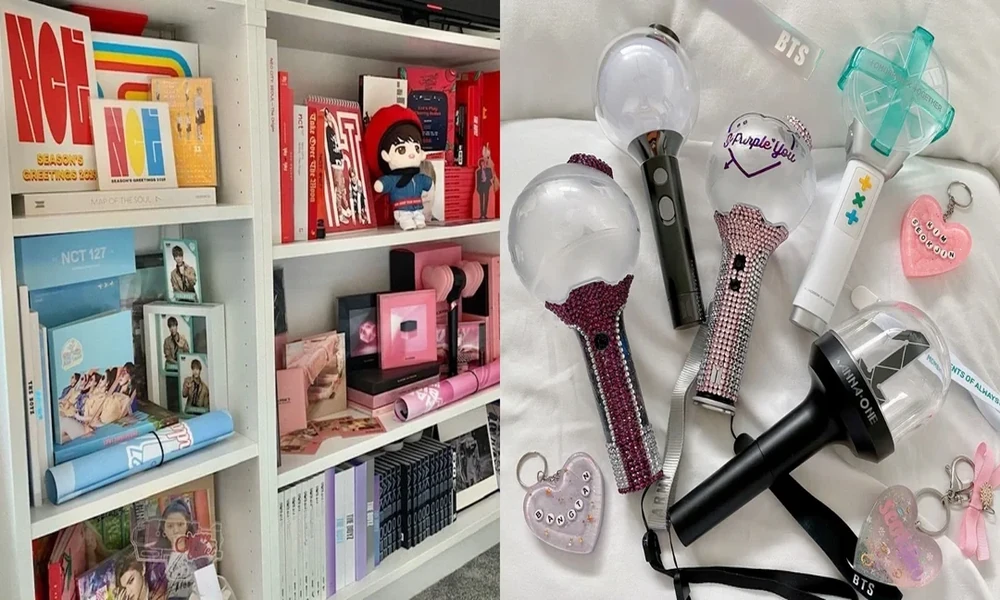
Forty dollars a month. That’s what plenty of K-pop fans spend before they even think about concert tickets. What started as buying a single album to support a favorite group has evolved, quietly and then all at once, into one of the most organized collecting hobbies on the planet. There are spreadsheets, Discord servers, dedicated display shelves, and a secondary market worth millions. If you’ve ever wondered why your friend has six copies of the same album, this is your answer.
Why Collecting K-Pop Merch Hits Different Than Other Fandoms
Most music fandoms sell you a T-shirt and call it a day. K-pop agencies treat every product release like a cultural moment. An album isn’t just twelve tracks. It’s a photobook, a set of photocards, a postcard, a poster, and sometimes a folded lyric sheet printed on thick matte paper that feels genuinely special in your hands. Each version of the same album might feature a different member’s concept photos, which means collectors who want the full set need multiple copies.
That design philosophy is deliberate. K-pop CDs typically come with unique packaging that makes them attractive for consumers to buy and collect, with each album usually including a photobook and freebies such as photocards or stickers. The photocard alone can turn a routine purchase into a treasure hunt. You never know which member’s card you’ll pull, so trading culture explodes naturally around each release.
The result is a hobby that feels closer to sports card collecting or vinyl hunting than to ordinary music fandom. You’re building something. You’re curating something. And the community rewards you for it at every turn.
The Numbers Behind the Obsession
This hobby isn’t niche anymore, and the spending data makes that obvious. The U.S. music market analysis firm Luminate, in its 2023 Annual Report, highlighted K-pop merchandise as “big business,” revealing that U.S. K-pop fans spend an average of $24 per month on merchandise, which is 2.4 times higher than the average American music listener. That gap holds even when you compare K-pop fans to fans of other globally popular genres. U.S. K-pop fans are also 50% more likely to purchase related merchandise even when they cannot attend an artist’s music event , according to the same report from allkpop’s January 2024 coverage of the Luminate data.
Merchandise spending is only one slice of the pie. Physical albums are their own category entirely, and the export numbers from South Korea tell the full story of scale.
| Category | Detail |
|---|---|
| U.S. K-pop fan merch spend | $24/month avg. (Luminate, 2023) |
| vs. average U.S. music fan | 2.4x higher |
| International K-pop album export sales | $291.8 million (Korea Customs Service, 2024) |
| IFPI top 20 global album sales held by K-pop acts | 17 of 20 (IFPI, 2024) |
Physical Albums in a Streaming World
Here’s the counterintuitive part: physical album sales should be declining. Streaming is cheap, instant, and infinite. Yet K-pop collectors are buying more physical product than ever. According to the Korea Customs Service, international sales of physical K-pop albums reached $291.8 million in 2024, with most of that value coming from special editions, collections, and limited items that carry symbolic and emotional weight for fans. You can read the full breakdown at HallyuTones’ November 2025 report on K-pop fan consumption.
The reason physical albums survive streaming is exactly the reason any collectible survives its digital equivalent. A photocard can’t be streamed. A signed poster can’t exist on Spotify. The object carries meaning that a playlist file never will. K-pop agencies understood this early, and they’ve built an entire product ecosystem around it.
I’d argue this makes K-pop one of the smartest physical collectibles markets out there right now. The items are globally recognized, frequently limited in print run, and tied to an intensely active community that assigns value publicly and in real time.
BTS as the Blueprint for Collector Culture
No conversation about K-pop collecting is complete without acknowledging BTS. They didn’t invent the format, but they scaled it to a level that made the rest of the world pay attention. An “unprecedented” 19 of the top 20 titles on the IFPI Global Album Sales Chart were created by South Korean acts in 2023, demonstrating K-pop’s “global dominance of the physical album format,” according to a statement from the IFPI , as reported by Billboard in March 2024. BTS led that charge for years before the current generation of groups inherited the model.
For collectors building a dedicated collection, BTS albums and merch represent some of the most recognized and traded items in the hobby. Certain versions of older albums have become genuinely hard to find, which means condition and authenticity matter more the deeper you go into the back catalog.
One ARMY member described the appeal plainly in a fan interview cited by Vice: “Collecting and buying these items make you feel more connected to the fandom, and you also feel like you’ve contributed to the band. Everyone’s got their own hobby and mine is collecting BTS merch.”
“Collecting and buying these items make you feel more connected to the fandom, and you also feel like you’ve contributed to the band.” – BTS fan quoted in Vice, August 2024
That sentiment isn’t unique to ARMY. You’ll find nearly identical language in fan forums for SEVENTEEN, Stray Kids, and aespa. The feeling of contribution through ownership is baked into the culture.
The SCOOP Framework: How Serious Collectors Approach the Hobby
If you’re new to this or trying to get more intentional about your collection, the easiest way to think about it is through what I’d call the SCOOP framework. It’s not a formal system anyone else uses, but after following this hobby closely, it describes exactly how the most organized collectors approach their shelves.
- Scope: Decide upfront whether you’re collecting one group, one era, or one format. Trying to collect everything is a fast path to a very expensive mess.
- Condition: Sealed albums hold the most resale value. If you’re opening them, do it carefully and keep original packaging.
- Originals vs. reprints: First pressings and limited versions are not the same as later standard editions, even when the music is identical.
- Organization: Photocards stored in binders with labeled sleeves, albums spine-out on shelves by release date. Your future self will thank you.
- Provenance: Know where your items came from. Unofficial goods and bootlegs circulate widely. Buy from reputable sources so you know what you actually have.
The SCOOP framework works whether you’re three albums in or three hundred. What changes as you go deeper is how much you care about each category. Early collectors focus on Scope. Experienced collectors obsess over Provenance.
Trading, Community, and the Photocard Economy
The secondary market around photocards alone is a hobby within the hobby. A rare member card from a limited pressing can fetch prices that surprise outsiders. Fans trade them in person at fan meets, ship them internationally with tracking, and post their “pulls” on social media the same day a new album ships. There are established grading conventions, standard sleeve sizes, and unwritten rules about what makes a fair trade.
This is where the social dimension really lives. Your collection connects you to a worldwide network of people who know exactly what you’re talking about when you mention a specific album version or a hard-to-find unit photocard. That shared language is part of what makes K-pop collecting stick as a long-term hobby rather than a passing phase for most fans.
So whether you’ve got one shelf dedicated to a single group or you’re deep in spreadsheet territory tracking every version you still need, the hobby has room for you. The real question is how far down you want to go. Because most collectors, given enough time, always want to go a little further.