

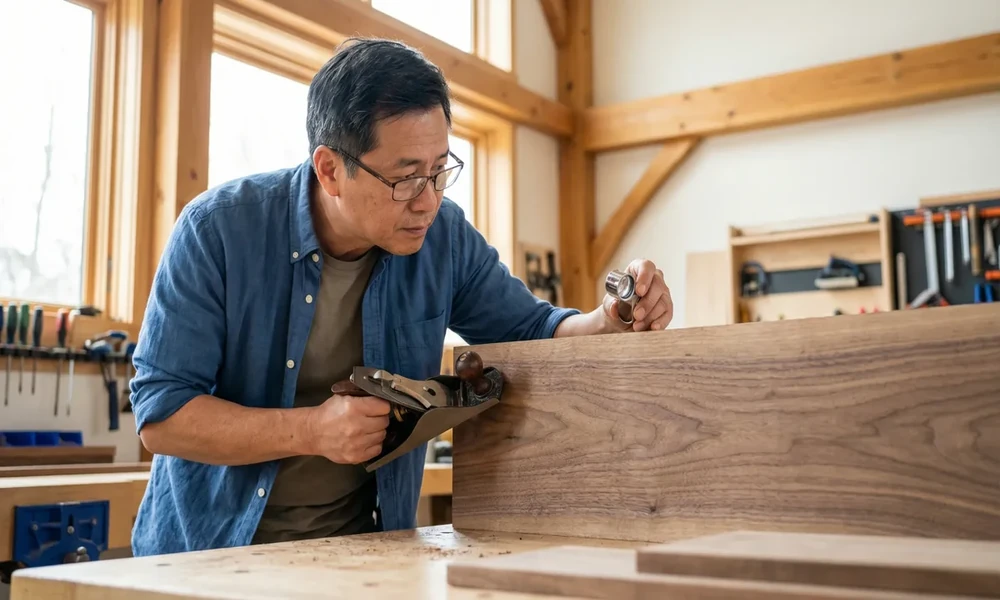
Twelve years ago I watched a guy in a drafty shop in Livingston reject a walnut board because of a knot the size of a dime. He set it aside, pulled another off the stack, and started over. That board became the top of a dining table that’s still in my aunt’s kitchen. The knot didn’t matter to anyone but him, and that’s the whole difference between factory furniture and the real thing.
If you’re shopping for solid wood furniture, the marketing language gets thick fast. “Heritage quality,” “heirloom,” “built to last.” Those phrases mean nothing on their own. What means something is the process behind them. Below is how custom wood furniture actually gets made, what separates a piece that survives forty years from one that wobbles by year three, and the exact questions to ask any maker before you hand over a deposit.
Where the Wood Comes From Matters More Than the Finish
Most people obsess over stain color. Pros obsess over moisture content. A board that hasn’t been dried properly will move, crack, and cup no matter how beautiful the grain looks on delivery day.
Hardwood suppliers kiln-dry lumber to a moisture level matched to the climate where the finished piece will live. In a dry mountain climate, that target is different than it is in coastal humidity. According to the U.S. Forest Service, wood continues to exchange moisture with the surrounding air for the life of the piece, which is why proper drying before construction is the single most important step in the entire build. Skip it and you’re buying a countdown timer.
Species selection follows the same logic. Walnut machines beautifully and holds detail. White oak resists moisture and takes a beating. Cherry darkens over time in a way a lot of people love and a few people hate. Maple is dense and pale and shows every ding. None of these is “best.” The right one depends on whether the piece sits in a lake house or a Denver loft, and whether kids or dogs or both will be climbing on it.
Here’s my stance: if a maker can’t tell you where their lumber came from and how it was dried, walk. It’s not a red flag, it’s a red banner.
The Build: Joinery, Not Glue and Hope
This is where the price gap between a $400 big-box table and a $4,000 custom one gets explained.
Cheap furniture relies on butt joints, pocket screws, and particleboard cores wrapped in veneer. It assembles fast, ships flat, and fails at the joints because screws pull out of soft material over time. Custom work uses joinery that locks wood to wood.
- Mortise and tenon: a projecting tongue fits into a matching cavity, often pinned for extra strength.
- Dovetail: interlocking wedge shapes that resist pulling apart in any direction. Common in drawer boxes.
- Biscuit and dowel joints: hidden reinforcement that adds alignment and surface area for glue.
- Breadboard ends: the strip across the end of a tabletop that allows the wide boards to expand and contract without splitting.
You don’t need to memorize these. You do need to hear a maker say them without hedging. Ask what joinery is used at the corners of a table, the corners of a drawer, and the connection between the legs and the apron. If the answer is “screws and glue,” that’s your answer about longevity too.
A concrete example: a client of mine ordered a farmhouse table with breadboard ends and trestle legs for a rental cabin near Whitefish. Renters abused that table for six winters. Wet glasses, hot pans, a kid carving initials into an end. The breadboard ends let the top move through the seasons without splitting, and the trestle base never racked. A veneered table in the same room would have been landfill within two years.
Fifteen Questions I’d Ask Any Maker Before Paying a Deposit
Print this, or save it on your phone, and take it to the shop visit. The answers tell you more than any showroom does.
- Which species do you recommend for my climate and my use case, and why?
- What is the moisture content of your stock, and how do you verify it?
- What joinery do you use at the corners, the drawers, and the leg-to-apron connection?
- Will you let the top float for seasonal movement, or fasten it rigid?
- What finish system do you use, and how do I repair a scratch at home?
- Can I see a piece you built ten or more years ago?
- Who actually builds the piece, and do they build it start to finish?
- What’s the lead time, and what causes it to slip?
- What’s your deposit structure, and how are changes priced after the build starts?
- Can I visit the shop during the build?
- What’s your written warranty, and what does it cover?
- How do you handle a board that moves after delivery?
- Do you charge for design revisions, and how many are included?
- Can you match a finish to an existing piece in my home?
- What happens if I measure wrong and the piece doesn’t fit?
Question six is the one most people skip and the one that matters most. Anyone can show you a finished piece on delivery day. Very few can show you fifteen years of one.
A Small Business Built One Piece at a Time
Custom furniture shops are almost always small operations, and that’s not an accident. The work doesn’t scale the way a factory does, because the value is in individual attention to grain, joinery, and fit.
According to the U.S. Small Business Administration, small businesses make up the overwhelming majority of employer firms in the country and account for a substantial share of net new jobs. Furniture workshops sit squarely in that world. When you buy from one, you’re not just getting a table. You’re paying a person in your region to keep doing skilled work, and you’re often keeping money in the local economy instead of routing it through a warehouse three time zones away.
There’s a practical angle too. A small shop can match a finish to your existing floors, cut a piece to fit an awkward wall, and answer the phone when something needs adjusting. That flexibility is almost impossible to get from a national retailer, and it’s why a lot of people end up going custom even when the price stings.
This is also where regional styles come into play, and it’s the reason Handcrafted Furniture in Montana tends to look different from what you’d find in a coastal showroom. Live edge slabs, reclaimed barn wood, chunky legs, and finishes that let the grain do the talking rather than hiding it under a heavy stain. If that aesthetic fits your home, working with a maker who builds in that tradition from the start saves you months of trying to approximate it with catalog pieces.
Cost, Lead Time, and What Actually Drives Price
Nobody likes this section, so I’ll be blunt. Custom solid wood furniture costs more because it takes more labor and better material. That’s the whole story.
Three things move the number most: species (walnut and white oak cost more than pine or alder), complexity (curves, inlays, and custom sizing add hours), and finish (hand-rubbed oil versus sprayed lacquer changes material cost and shop time). Lead times typically run several weeks to a few months depending on backlog. According to the Bureau of Labor Statistics, skilled production and craft roles remain a meaningful share of the manufacturing workforce, which is a polite way of saying that good hands aren’t cheap and shouldn’t be.
If the quote feels high, ask what’s driving it. A good maker will break it down without getting defensive. A bad one will get vague.
How to Tell You’re Buying Something That Lasts
Run this mental checklist before you commit.
Feel the weight. Solid wood is heavy. If you can lift a dining table with one hand, it’s not solid.
Look at the end grain. Solid wood shows growth rings. Veneer shows a thin layer and a different core.
Check the underside. The bottom of a piece tells you whether the maker cared. Rough, splintery undersides are a tell.
Ask about repair, not just replacement. Good furniture gets fixed, not thrown out.
Trust the shop visit. Sawdust on the floor and half-built pieces on sawhorses are good signs. A showroom with no workshop behind it is a question mark.
Do those five things and you’ll avoid most of the mistakes people make in this category. You’ll also probably spend more than you planned, and you’ll stop thinking about it within a year because the piece just works.
Furniture You Stop Noticing Is Furniture You Got Right
The best compliment a piece of furniture can earn is invisibility. You stop thinking about the table because it never wobbles, never needs tightening, never gets shoved against a wall to hide a crack. It just holds dinner every night for twenty years.
That doesn’t happen by accident. It happens because somebody dried the lumber properly, cut a real joint instead of driving a screw, and let the top expand the way wood needs to. None of that shows up in a listing photo. All of it shows up in year fifteen.
So before your next furniture purchase, do the prep work. Visit a shop, ask the fifteen questions, and look at a ten-year-old piece. Then decide whether the price still feels high, or whether it finally makes sense.