

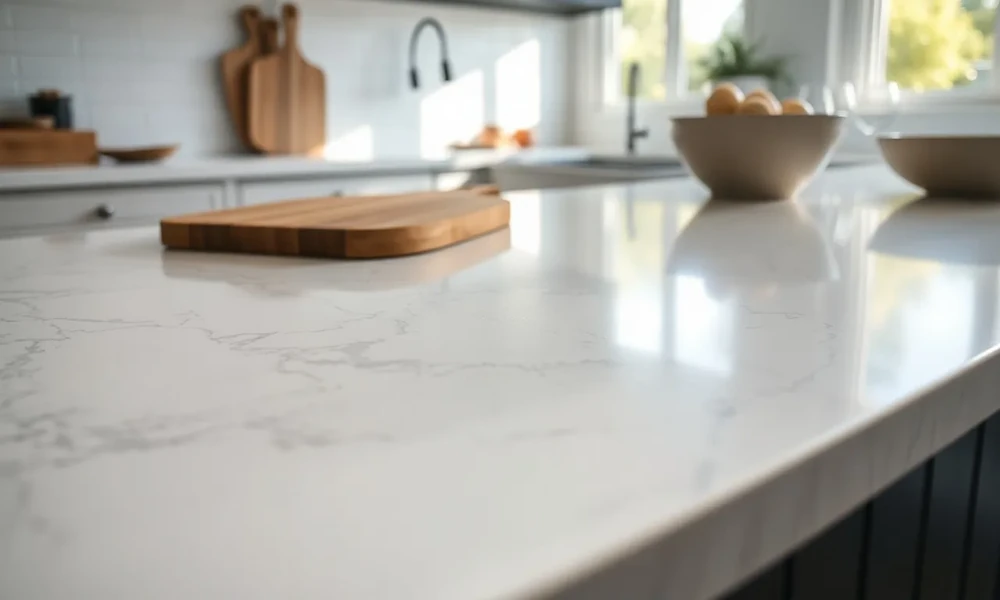
Ten years from now, your kitchen will be judged by three things: the cabinet fronts, the floor, and that slab you eat breakfast on. Nobody walks into a kitchen and compliments the drywall.
So here is the stance up front. Of every surface you can put on a counter, quartz is the one most homeowners regret least, mostly because it asks almost nothing of you after install day. No sealing every spring, no panic over a spilled glass of red wine, no hunting for the right stone soap. You wipe it down and move on with your life.
That said, the slab you pick matters a lot more than the material name on the showroom card. Two kitchens can have the exact same quartz and look completely different, one glossy and generic, one that looks like it was quarried for the room. If you are near St. Louis and weighing your options, this premium quartz countertops page from E&B Granite lays out the material comparisons side by side. What follows is the part most showrooms skip: how to actually pick a slab you will still like in a decade.
Why quartz shrugs off the daily abuse
Quartz surfaces are engineered, not mined as a single block. Crushed stone gets bound with resin, which is why the color runs all the way through and why the surface comes out non-porous. That non-porous part is the whole story. Liquids sit on top instead of soaking in, so coffee, oil, and juice don’t leave shadows behind.
Compare that to natural stone, which is beautiful but wants attention. The Marble Institute of America has documented for decades why porous stone needs sealing, and anyone who has owned a marble counter knows the drill. Quartz skips that chore entirely. If you’d rather spend your Saturday grouting the backsplash than re-sealing the island, this is your material.
My honest take: the sealing ritual is the single most overrated factor in countertop shopping. It’s fifteen minutes twice a year. But it’s fifteen minutes you’ll forget to do, and then you’ll be scrubbing a stain out of marble at midnight. Buy the surface that forgives you.
The slab color question nobody asks early enough
Here’s what I’d tell a friend standing in a slab yard: pick your quartz before you pick your paint. Most people do it backward, commit to a bold cabinet color, then discover every slab under the lights clashes with it. Quartz patterns are busy by nature. Big veining, tiny speckles, a subtle marble-look. The room reads that pattern first, before the cabinets, before the hardware.
So walk the yard with your cabinet sample, your floor tile, and a photo of your light fixtures on your phone. Look at each slab from six feet away, not six inches. The close-up view sells slabs. The six-foot view is what you’ll actually live with.
Three slab styles and who they suit
- Heavy veining: dramatic, best in a big kitchen where the island has room to breathe, and paired with plain cabinets so the two don’t fight.
- Fine speckle: the workhorse, hides crumbs and water spots, ages gracefully in busy family kitchens.
- Soft marble-look: elegant and calm, but the pale tones show every splash, so it rewards people who actually wipe down nightly.
Notice the pattern here. The style you love and the style you can maintain aren’t always the same slab. Pick the intersection of the two and you’re set.
Thickness, edges, and the details that date a kitchen
Quartz typically shows up at two centimeters or three centimeters thick. The thicker profile looks substantial and overhangs well on an island. The thinner one saves money and works fine on a standard run of cabinets, especially with a built-up edge that mimics the look of a chunkier slab.
Edges are where kitchens show their age. Waterfall edges, mitered aprons, and chunky square profiles photograph beautifully. Rounded bullnose edges tend to read as dated a few years out. The safe pick in almost every home is a simple eased or squared edge. It’s cheaper, easier to clean, and it doesn’t announce the year it was installed.
One more detail worth getting right: the seam. Fabricators place seams at natural break points and match the pattern across them when the slab allows. Ask to see the seam layout on paper before anything gets cut. A good seam is barely visible. A bad one looks like a scar.
Where quartz actually struggles
No material is invincible, and quartz has one real weakness: heat. Resin doesn’t love a hot pan set down directly, and prolonged exposure can scorch or discolor the surface. The fix costs nothing. Keep a couple of trivets on the counter and use them. That’s the entire maintenance contract.
Direct sun is the other one to watch. UV exposure over long stretches can fade some quartz colors, particularly the deep reds and blacks. If the island faces a wall of south-facing windows, mention it to your fabricator and ask about options rated for sun exposure. According to the National Institute of Standards and Technology, material performance under sustained environmental exposure is exactly the kind of question worth asking before you commit. Little ask, cheap insurance.
A five-step walkthrough for picking your slab
- Set a budget range, not a number. Quartz prices swing with pattern complexity and slab thickness. Know your ceiling before you walk in so a dramatic slab doesn’t blow up the whole project.
- Bring physical samples. Cabinet door, floor tile, a paint chip. Not photos. Screens lie about color, and slab yards have terrible lighting.
- View slabs in daylight and under showroom light. The same quartz can look warm at noon and cool at 6 p.m. You’ll live with both.
- Confirm the seam plan in writing. Where the seams land, how the veining aligns, and who handles the cutouts for sink and cooktop.
- Ask about the install crew, not just the slab. A flawless slab installed badly is a flawed countertop. Fabrication quality is half the product.
Step four is the one people skip. Don’t skip it.
The sustainability angle you’ll probably get asked about
Quartz contains a high percentage of crushed natural stone bound with resin, which means it uses less raw quarried material per square foot than a solid stone slab. The resin binder is the tradeoff, and sourcing and manufacturing practices vary by brand. The Environmental Protection Agency maintains public resources on indoor air quality and material emissions if you want to dig into what binders and finishes mean for a home. It’s the kind of homework that matters more in small kitchens with less airflow. Worth a quick look before you fall in love with a slab.
The bottom line on quartz
Quartz earns its place because it removes work from your life instead of adding it. You don’t seal it, you don’t baby it, and you don’t have to think about it after the install crew leaves. The only real decisions are texture, thickness, edge profile, and seam placement, and none of those need to be hard if you slow down at the slab yard instead of the checkout counter.
Here’s the question I’d leave you with: if you’re already picturing the kitchen ten years out, what does the counter look like in your head? If it’s clean, calm, and still the same color you picked, quartz is a safe bet. If you want the wild grain of a natural slab, that’s a fair choice too, as long as you know what you’re signing up for.