

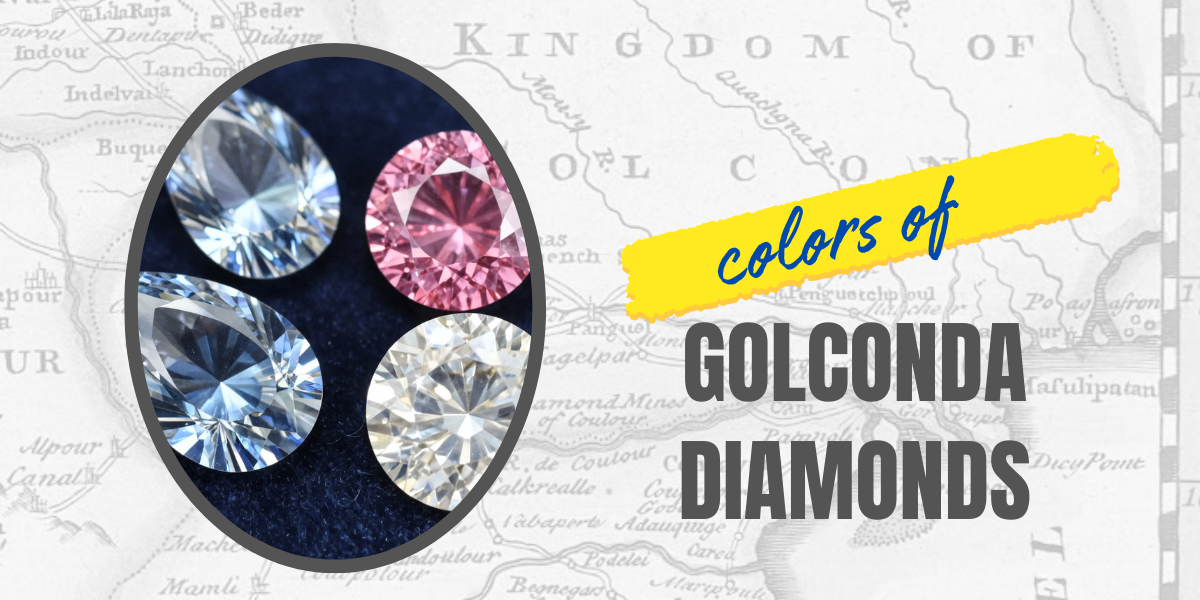
For centuries, the diamond fields of Golconda have occupied a near-mythic place in gemological history. Located in present-day India, the Golconda region was once the world’s most celebrated source of natural diamonds, renowned particularly for producing stones of extraordinary purity and transparency. While these mines are most famous for yielding Type IIa white or colorless diamonds, they also produced—on exceedingly rare occasions—colored diamonds of remarkable beauty and scientific importance. Among these, blue and pink Golconda diamonds stand out not only for their rarity but also for their distinct geological origins and gemological characteristics. Notably, the Golconda diamond mines have not been commercially mined for the past three centuries, making their surviving gems finite relics of a vanished natural treasure.
Geological Reputation of Golconda Diamonds
Golconda diamonds were largely extracted from alluvial deposits, especially from historic workings such as the Kollur Mine. Unlike many modern deposits, these stones were formed deep within the Earth under extremely stable conditions that produced diamonds with almost no nitrogen impurities. This explains why many Golconda stones fall into the Type IIa category, the rarest and most chemically pure diamond classification. Their exceptional transparency and optical performance set a benchmark still used today to judge diamond quality.
BLUE GOLCONDA DIAMONDS – Type IIb Marvels
Although Golconda is synonymous with colorless stones, it occasionally yielded blue diamonds. These stones belong to the Type IIb classification, meaning their color originates from traces of boron atoms within the crystal lattice. Type IIb diamonds are extraordinarily rare worldwide, and Golconda examples are among the most historically significant.
The Hope Diamond
Perhaps the most famous blue diamond in existence, the Hope Diamond is widely believed to have originated in the Golconda region. Weighing 45.52 carats in its current form, it is celebrated for its deep blue hue and red phosphorescence under ultraviolet light. Today it is housed in the Smithsonian Institution, where it remains one of the most visited gemstones in the world.
The Seraphim Blue Diamond
Often cited in private collections and online reports, the Seraphim Blue Diamond is described as a vivid blue Golconda stone admired for its clarity and saturated tone. Though less publicly documented than the Hope, it is frequently referenced in discussions of rare Golconda blues. The old mine-cut pear shape blue diamond, was once worn by Asaf Jah 1 the Nizam of Hyderabad in a lavish turban ornament.
The Golconda Blue Diamond
This name has been used in trade circles for a historic blue diamond attributed to the region. Stones bearing such provenance labels are typically small but intensely colored, emphasizing how rare blue output was from these mines. The most talked about the Golconda Blue Diamond, relates to a cancelled auction by none other than Christie’s!
The Wittelsbach-Graff Diamond
Another notable blue diamond associated with Indian origins, this historic gem once formed part of European crown jewels. It is admired for its steely blue tone and storied royal history, further illustrating the global reach of Golconda diamonds.
These examples of blue color diamonds demonstrate that while blue Golconda diamonds exist, they represent only a minute fraction of the region’s output. Their scarcity, combined with the scientific rarity of Type IIb diamonds, places them among the most valuable gemstones ever discovered.
PINK GOLCONDA DIAMONDS – Structural Wonders
Pink diamonds from Golconda are even rarer than blue ones, and their coloration arises from a completely different mechanism. Unlike blue diamonds, whose color comes from chemical impurities (boron), pink diamonds owe their hue to structural distortions in the crystal lattice. These distortions alter how light travels through the diamond, producing shades ranging from faint blush to vivid rose.
Importantly, Golconda pink diamonds are typically Type IIa stones—the same chemically pure category as the region’s famed white diamonds. Their color is therefore not due to trace elements but, to natural atomic displacement caused by intense pressure during formation.
The Nizam’s Turban Ornament Diamond
Historical accounts describe a remarkable pink diamond believed to have adorned a ceremonial turban worn by Asaf Jah I, ruler of the princely state centered in Hyderabad. Though its present whereabouts are uncertain, the gem is often cited as an example of a rare pink Golconda diamond that combined noble provenance with unusual coloration. This diamond is occasionally mentioned, along with the Seraphim Blue Diamond – another blue diamond from Golconda, that was also set in a Nizam’s turban ornament.
The Darya-i-Noor
One of the largest pink diamonds known, this historic stone is famed for its pale rose color and exceptional size. Believed to originate from Indian mines, it is regarded as one of the most important pink diamonds in existence. Experts agree that there are indications that, this pink diamond has a Golconda origin.
The Noor-ul-Ain Diamond
Likely cut from the same rough crystal as the Darya-i-Noor, this pale pink diamond is admired for its soft tone and royal associations. Its delicate coloration exemplifies the subtle beauty typical of natural pink diamonds from ancient deposits. This pink diamond like many other Golconda diamonds, has a narrative that cannot be entirely confirmed with a high degree of certainty.
The Princie Diamond
A vivid pink diamond historically linked to Indian royalty, the Princie is celebrated for its saturated color and excellent clarity. Its documented provenance and vibrant hue make it one of the most valuable pink diamonds ever sold at auction.
Together, these stones illustrate how exceptionally scarce pink Golconda diamonds are. Only a handful have credible historical attribution to the region, and each commands intense interest from collectors and scholars alike.
WHITE GOLCONDA DIAMONDS – The Benchmark of Purity
While colored diamonds capture public imagination, the true legacy of Golconda lies in its colorless stones. Many legendary diamonds—including the Koh-i-Noor, the Regent, and the Great Mogul—are believed to have originated there. These gems are celebrated for their limpid transparency, often described as possessing a “liquid light” appearance. Their Type IIa purity places them among the most chemically flawless diamonds ever found.
Such stones helped establish Golconda’s reputation as the historic source of the world’s finest diamonds. Even today, gem dealers sometimes use the term “Golconda quality” to describe diamonds of exceptional clarity and brilliance, regardless of origin.
RARITY OF GOLCONDA COLOR DIAMONDS
Several factors explain the rarity of colored diamonds from Golconda:
- Geological Conditions – The environment that produced Golconda diamonds favored pure carbon crystallization with minimal impurities, leading predominantly to colorless stones.
- Trace Element Scarcity – Elements like boron, responsible for blue coloration, were rarely present in the region’s geological setting.
- Structural Stress Events – The lattice distortions needed to produce pink coloration occurred only under very specific pressure conditions, making such stones exceptionally uncommon.
- Limited Mining Era – Since the mines ceased commercial production roughly 300 years ago, no new supply can emerge, permanently fixing the number of existing Golconda diamonds.
HISTORICAL COLLECTIBLE SIGNIFICANCE
Golconda diamonds occupy a unique intersection of science, history, and art. They have adorned emperors, shahs, maharajas, and monarchs, and they continue to appear in museums and high-profile auctions. Because the mines are long exhausted, every confirmed Golconda diamond is a finite artifact of geological history.
Collectors prize these stones not only for their beauty but also for their provenance. Documentation linking a diamond to Golconda can dramatically increase its value, particularly for colored examples. Blue and pink Golconda diamonds, being doubly rare—first as colored diamonds and second as Golconda stones—represent the pinnacle of rarity in the gemstone world.
QUICK SUMMARY
The diamond mines of Golconda stand as one of history’s greatest natural treasure sources. Though primarily famed for producing flawless Type IIa white diamonds, they occasionally yielded colored stones of extraordinary rarity. Blue Golconda diamonds such as the Hope, the Seraphim Blue Diamond and the Wittelsbach-Graff demonstrate the unusual presence of boron in their structure, while pink examples like the Darya-i-Noor and the legendary Nizam’s ornament stone reveal how structural distortions alone can create color in chemically pure diamonds. With the mines dormant for three centuries, every surviving Golconda diamond—especially the rare colored varieties—remains a priceless testament to nature’s artistry and the enduring allure of the world’s most storied diamond source.